Slavery by the Numbers
Last night we heard an interesting talk on “Cotton in the Civil War” with the sub-title, “Slavery by the Numbers”. Stan Weinstein was our presenter for the evening. We’ve had the pleasure of hearing a number of talks hosted by Stan, and it was an interesting discussion we had that night. If only the screen projector worked!
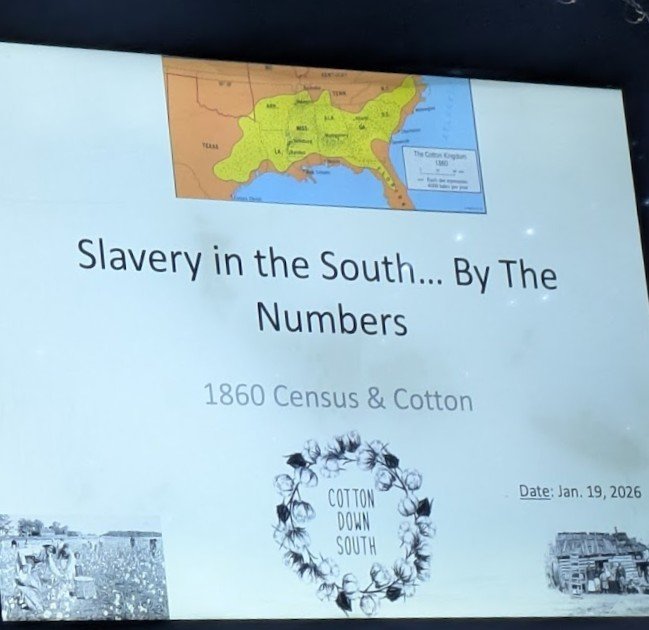
Stan deserved a medal for his patience with the often-failing IT tech support folks of Draught 55. At the end he just gave up, and gave a talk on numbers without having any visuals to back it up! His theme was “Slavery by the Numbers”, with special emphasis on the 1860 Census. Stan noted the special coincidence of our meeting in coincidence with Martin Luther King ‘s holiday in January.
In the Civil War, he noted, the South was an agrarian society based on enslaved labor. He mentioned the various reasons why the South justified slavery, including the sense of inevitable history (Rome had slaves…Greece had slaves…) which was sanctioned in the Bible and was bolstered by the supposed biological “fact” that Blacks were subhuman and were better suited for back-breaking work in the field. Another population “justification” for slavery was the so-called Mudsill theory: society was established on the basis that the lower classes should form the “mudsill”, as the foundation on which the rest (the ‘higher’ or ‘superior’ people) rose up. The South Carolina senator James Hammond was the primary spokeman of the view that slavery resided on the “great truth” that Black people were thought to be inferior to White people.
Senator Hammond was also author of the phrase, “Cotton is King”. This cash crop depended on slavery. An estimate put the value of all slaves in the US before the Civil War at roughly 3 billion US dollars (in 1861 terms), equivalent to the 3 billion dollars of estimated value of all manufacturing in the North.
Although on the aggregate slaves represented only around 10% of the total population in the South, these enslaved Americans made up almost 40% of the population in the intense cotton-producing areas in the 5 states initially seceding from the Union. Of the total 4 million slaves in the US, most of them (3 million) worked on large plantations. On the average, there were 11 slaves per 1 head of household in the South before the War, but that average was distorted by the fact of high concentration of slaves on the large plantations. Seventy-one planters in one county of Mississippi, each with thousands of slaves working on their land, were the richest people in the US at the time.
This point led Stan to raise an interesting question as to why the South was able to recruit so many White soldiers to fight in the cause to defend slavery. Only around 1/3 of all White heads of households were slave owners, so why were the remaining 2/3 of White families fighting to defend the slave system even though they were not slave-owners themselves? Those non-slave owners rose up to join the Confederacy, to defend against what they perceived as an invasion by the North. Stan pointed out that Lincoln was careful to brand himself as the “defender of the Union” (instead of opponent of slavery”) because an outright attack on slavery would not have won popular support in the North. After Antietam and the Emancipation Proclamation, Lincoln was able to add “free the slaves” to the goal of “defend the Union”.
The introduction of the new cotton gin (the ‘cotton engine’) transformed the cotton-growing economy, allowing it to be much more productive for barrels of cotton with a given input of slave labor. By 1861, cotton represented nearly two-thirds of all goods exported by the US. Legally the US no longer allowed imports of slavery into the country as of 1808, but the demand for production especially in the lands to the West (the “new South”) created a strong market for internal domestic slave trading within the US. “Sold down the river” was the phrase used to describe the trading of slaves from the old markets in the South to the new western States.
The British economy had a strong thirst for cotton imported from the US, and the aristocrats of the country supported the South. However, the pro-South sentiment in England was not shared by the working and middling classes of that country. In the face of the North’s blockade of shipping from the South, England diversified itself away from dependence on US cotton by boosting imports from Egypt and India. The only foreign office to formally recognize the South, was the Vatican.
“Cotton was king, it kept the South alive”.