
Our next meeting will be held at Draught 55 located at 245 East 55th Street
Price is $ 65 payable at the table. To rsvp, please contact Ann Plogsterth at either 212-877-6814 or plogsterth@aol.com
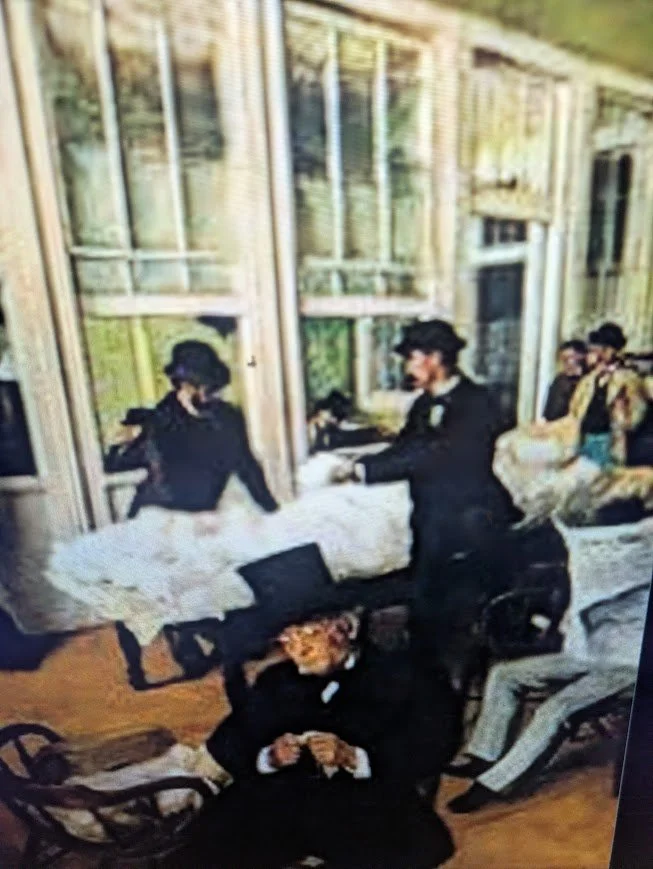
The Confederacy believed European nations, particularly Great Britain and France, were so dependent on Southern cotton for their textile industries that they would be forced to either intervene in the war or to at least grant diplomatic recognition to the South. To coerce Europe, Southern leaders enacted an informal embargo, even burning 2.5 million bales of cotton to create an artificial shortage.
The strategy failed because European mills had stockpiled surpluses from bumper crops in the late 1850s. By the time the "Cotton Famine" hit Europe in late 1862, alternative sources had been established in India, Egypt, and Brazil. Small fast ships slipped through the Union naval blockade to exchange cotton for vital military supplies, including weapons, ammunition, and even British-built warships like the C.S.S. Alabama. The Union's naval blockade aimed to suffocate the Southern economy by stopping cotton exports. As Union armies advanced into the South, they seized "contraband" cotton, sending it to Northern mills or selling it to fund their own war efforts. The high price of cotton—which quickly soared from 10 cents per pound to $1.89 per pound by 1864 (approximately $74 per pound in 2025 dollars!) led to rampant smuggling and illegal partnerships between Union officers and cotton speculators. The profitability of cotton had directly fueled the expansion of slavery into the Deep South, with over a million enslaved people quickly moved to labor on cotton plantations. After the war, restoring cotton production was considered absolutely essential for national recovery, and by 1870 production levels had finally surpassed those of 1860. This left many now "free" former slaves still hopelessly captured in life-long cycles of debt and poverty, with cotton still playing a major role in their lives of misery.
Our speaker for the evening will be Stan Weinstein, pictured on the right in the family photo below, who has spoken to our group several times before. His past topics have included Jews in the Civil War, and the Confederate Cabinet, and he has enjoyed those speaking engagements so much that he is now a member of our CWFMNY!

Stan had been in the advertising business for almost 40 years, working at such well known agencies as Grey Advertising, Marschalk, McCann-Erickson and Lois/EJL. Some of the accounts he has worked on include Coca-Cola; Nabisco (Ritz and Wheat Thins); Black & Decker (Dustbuster); US Airways; Heublein (Smirnoff Vodka); WNET/Channel 13; Minolta Cameras; New York State Lottery. After working in the advertising business, Stan took a teaching position in the business school at Hofstra University. He taught Advertising and Marketing on the graduate level for ten years. He is retired, but has focused his energies on developing and making presentations on a wide variety of subjects, such as the Civil War, Baseball , and various historical aspects of the Jewish Experience, such as Jews of the Wild West. Stan resides in Merrick, Long Island. He is married to his lovely wife Marcia and is a father of two great sons, Scott and Brian… and two fabulous grandsons, Trevor and Spencer.